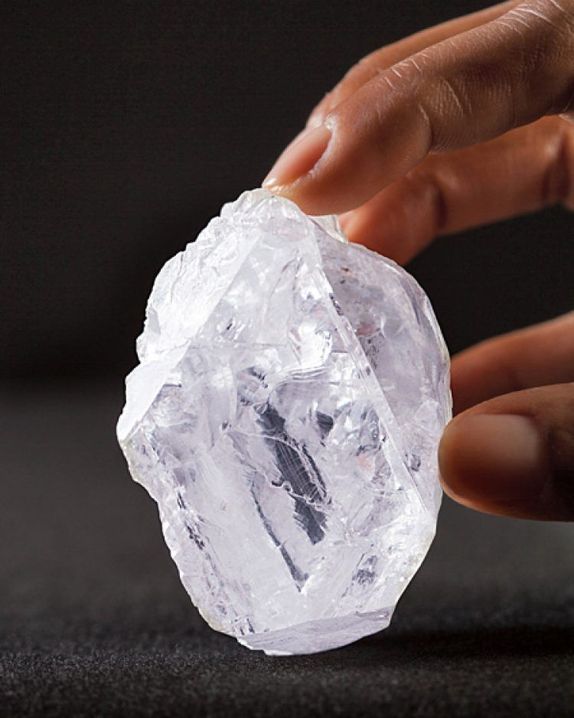
The terms brilliant-cut diamond and diamond are often confused. We will explain why it is useful to understand these terms when purchasing jewellery or a gemstone and how best to verify their authenticity.
The main difference between a brilliant-cut diamond and a diamond is that diamond is the name of a natural mineral, while brilliant refers to the diamond's cut. This is known as the brilliant cut, which is created only when a natural gemstone is cut and polished. It is then set in an engagement ring, earrings or another piece of jewellery.
What Is a Diamond?
A diamond is a rare and valuable gemstone composed of the crystalline form of carbon, C. A rough, uncut diamond forms deep within the Earth's crust under extremely high pressure and temperature. It is one of the hardest known natural minerals. Because of their high hardness, diamonds are widely used in industry: in industrial grinding wheels, drill bits and other tools. In jewellery, they are a symbol of luxury and elegance and are widely used to make pieces such as rings, necklaces and earrings.
Some of the most productive diamond deposits can be found in South Africa, Botswana, Australia and Russia. Investing in diamonds can also provide attractive capital appreciation.
What Is a Brilliant-Cut Diamond?
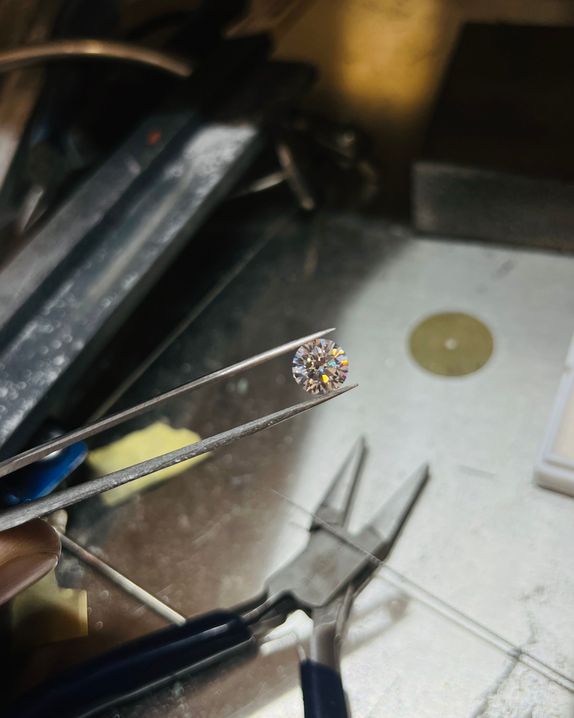
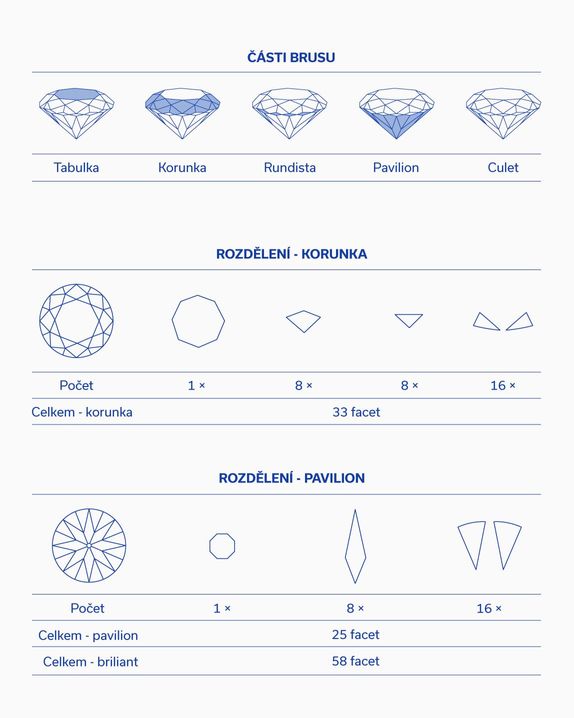
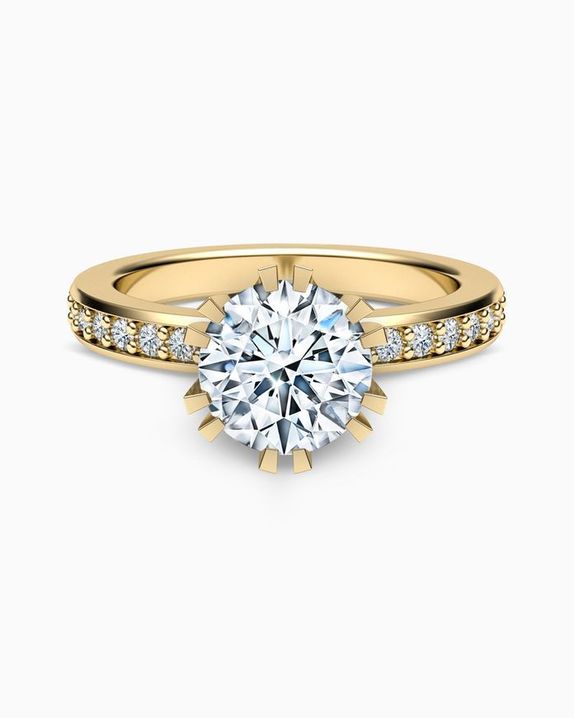
A brilliant refers to a diamond cut, not the raw material itself. The brilliant cut is a very popular type used in jewellery. This cut has 58 facets, consisting of one table facet, 33 upper facets and 25 lower facets. Thanks to these facets, light passing through the diamond is reflected in the best possible way across the full colour spectrum and at maximum intensity. This is why brilliant-cut diamond jewellery sparkles so beautifully and appears radiant and irresistible. Cutting is, however, a very complex process during which the original mined diamond loses an average of fifty percent of its original weight.
Who Developed the Brilliant Cut?
The brilliant cut was developed in the 17th century, although there is no definitive answer as to who exactly introduced this innovation. The history of brilliant-cut diamonds is based more on gradual evolution and refinement. The brilliant cut as we know it today was not perfected until the 20th century, when mathematical models were developed to determine the optimal proportions and facet angles for maximum light reflection. This work was presented by diamond cutters Marcel Tolkowsky and Henry Morse. In 1919, Marcel Tolkowsky published a book entitled Diamond Design, in which he presented his mathematical model for the ideal brilliant cut.
Not All Carats Are the Same
The price of a diamond is influenced by four key factors, known as the 4Cs: carat, colour, clarity and cut. Each of these factors plays an important role in determining a diamond's value.
Carat: is a unit of diamond weight (1 ct = 0.2 g). The larger the diamond, the higher its carat weight. It is important to note that the price of a diamond increases exponentially with its size. This is not the same carat as the one used for gold (kt), which indicates purity rather than weight.
Colour: colour is graded on a scale from D to Z, with colourless (D-F), near-colourless (G-J), faint colour (K-M), very light colour (N-R) and light colour (S-Z). Colourless diamonds are rarer and usually more valuable. The exception is so-called fancy-colour diamonds, where colour is desirable.
Clarity: in terms of diamond clarity, all stones contain inclusions. Sometimes, however, they are so small or subtle that they are quite difficult to identify even at thirty-times magnification. In coloured diamonds, imperfections are often almost concealed. The effect of inclusions on a diamond's value depends on their size and type, as well as where they occur within the stone. As the number of inclusions increases, the diamond's value decreases.
Cut: cut is considered the most important criterion because it affects the diamond's appearance, overall dimensions and ability to reflect light. There are several types of diamond cuts.
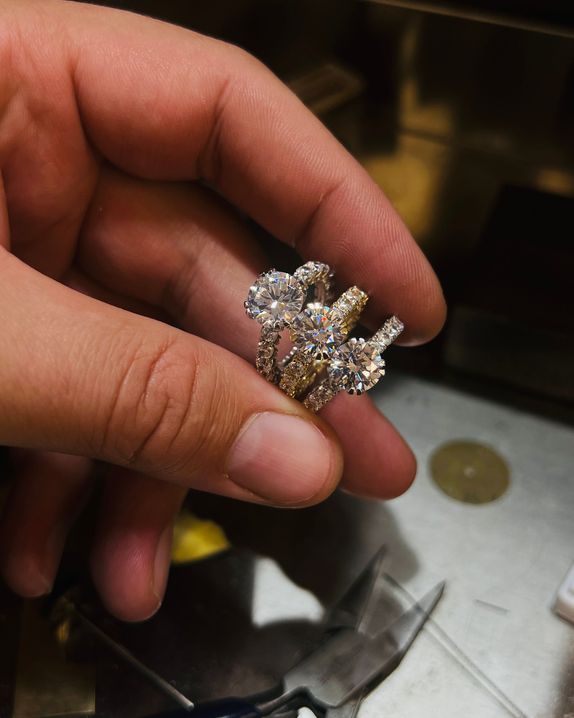
In addition to the classic 4Cs, several other factors can affect a diamond's price. These factors include:
Symmetry and facet position: symmetry plays an important role in a diamond's overall appearance and can affect its value. The quality of symmetry is assessed according to how well the diamond's facets are balanced and aligned. A symmetrical diamond will have facets that appear evenly distributed and balanced. Poor symmetry can result in irregular or distorted reflections of light within the diamond, affecting its brilliance and overall visual appearance.
Fluorescence: is a phenomenon in which a diamond emits a glow under ultraviolet light. The intensity of fluorescence can affect the diamond's appearance. Diamonds with strong fluorescence may be more affordable.
Diamond origin: some customers may consider the ethical and environmental origin of a diamond. Diamonds with certificates identifying them as conflict diamonds (also known as blood diamonds) may be less attractive to some customers. These are natural diamonds mined in areas where armed conflict has taken place or is still ongoing. Proceeds from these deposits are then used by rebel groups to finance military activities.
Is a Rough Diamond or a Polished Brilliant-Cut Diamond More Expensive?
A polished brilliant-cut diamond is usually more expensive than a rough diamond. The diamond-cutting process is demanding and requires the skills of experts who can create the optimal shape and cut so that diamonds reflect light as effectively as possible and produce beautiful flashes of brilliance.
Rough diamonds are unprocessed and irregular in shape. Cutting transforms a rough diamond into a beautiful, sparkling jewel. The factors that affect a diamond's price were described above according to the four key factors known as the 4Cs. Overall, a diamond's price depends on many factors, but a polished brilliant-cut diamond usually has a higher value than a rough diamond because it has undergone a demanding processing stage and achieved optimal aesthetic qualities.
Request a Certificate of Authenticity
A jewellery certificate of authenticity is an important document that provides information about the quality and characteristics of the gemstones used in the piece. We work with high-quality diamonds and gemstones with GIA or IGI certificates. The Gemological Institute of America (GIA) is a non-profit organisation and the world's most respected organisation specialising in the grading of diamonds, gemstones and pearls. In the 1940s, GIA created the 4Cs diamond grading system, establishing a global standard for assessing diamond quality that other laboratories still follow today. For some diamonds and gemstones, we issue our own certificates based on their specific characteristics.
We will be happy to advise you on choosing diamond jewellery. You can visit us in person at our showrooms in Brno and Prague or contact us by phone or email.