
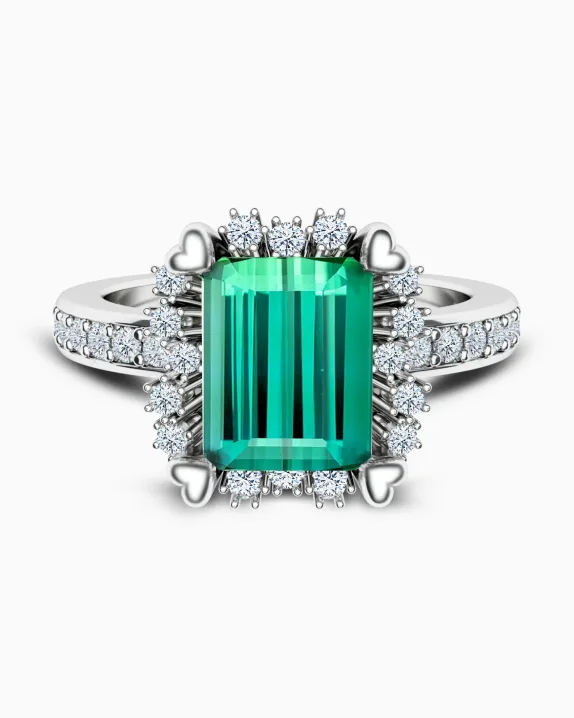
Tourmaline belongs among those gemstones that have a unique ability to enchant not only with their beauty but also with a fascinating story. Its name comes from Sri Lanka, from the Sinhalese people, who use the word “tura-malí,” meaning “stone of mixed colors.” Since ancient times, tourmaline has been considered a magical mineral. It can range from colorless to deep black. Its pink and red varieties were often mistaken for rubies.
Where can tourmaline be found?
Tourmaline is mined in many parts of the world. The most important deposits are found in Brazil, Afghanistan, Mozambique, Nigeria, and Sri Lanka. Each location produces stones with unique coloration. Brazilian tourmalines are famous for their clarity and wide range of colors, while African stones tend to have deeper and more intense shades. For jewelers, tourmaline is valuable also thanks to its hardness (7–7.5 on the Mohs scale) and relative durability.
An exceptional physical property of tourmaline
In the 18th century, Dutch traders brought it from Asia to Europe, where it quickly became popular not only among the nobility but also among scientists. Tourmaline is exceptional in that it can generate a weak electric charge when pressure is applied to it (a phenomenon known as the piezoelectric effect). At the time, this seemed like a miracle and earned it the informal nickname “Ceylon magnet.” In our article, you will also learn how tourmaline is connected to our history.
An endless spectrum of color combinations
Tourmaline is unique for its range of colors. Black tourmaline, also known as schorl, is among the most sought-after varieties thanks to its intense color. It looks elegant and highly distinctive, which is why it is so popular in the creation of modern jewelry. At the opposite end of the spectrum is pink tourmaline, whose delicate shade is perfect for romantic souls. It is also called the stone of love and looks stunning set in both gold and silver. Every shade of tourmaline has its own characteristics – from vivid green to blue to completely clear varieties. This colorful diversity is one of the reasons tourmaline has become so coveted among jewelers around the world.
The world’s most famous tourmalines
In the late 1980s, geologist Hector D. Barbosa discovered, near the state of Paraíba in Brazil, an entirely new type of tourmaline. This variety contained copper and displayed a vivid blue to green color. Around the world, this type became known as Paraíba tourmaline. It took the modern jewelry world by storm. A pair of earrings featuring Brazilian Paraíba tourmalines and diamonds was sold at Sotheby’s in Hong Kong in October 2020 for 406,000 USD.
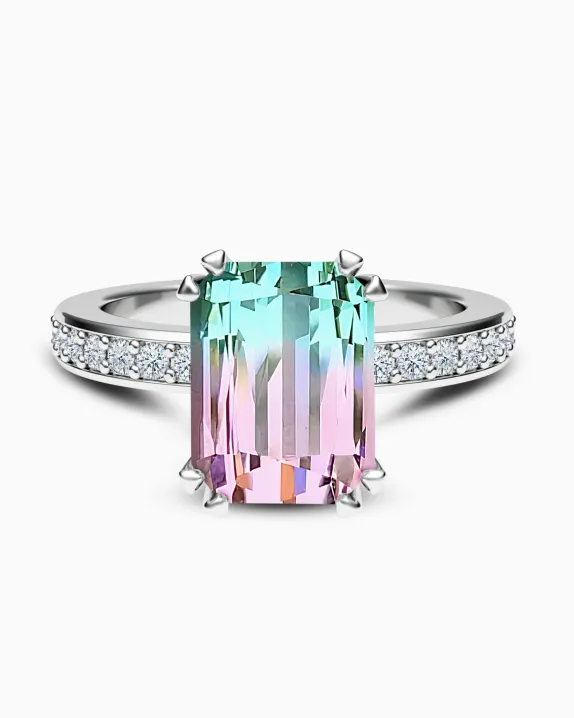
In our collection, you will also find unique bi-color tourmaline, adorning both rings and bracelets. Green tourmalines are especially popular, and in our selection you can find pieces set with them that will quite literally take your breath away. You can also enjoy their beauty in a more affordable form – set into a braided bracelet with a gold component – check out our Summer jewelry collection.
Pink tourmaline is said to symbolize love for humanity, worn to encourage and express compassion for others. It carries the virtue of unconditional love and friendship. It soothes negative emotions that often disrupt relationships.
The rise of tourmaline’s fame
The true potential of tourmaline as a gemstone was fully realized only in the 19th century, when new cutting and polishing techniques for gemstones were developed. Thanks to the efforts of George Frederick Kunz, the chief gemstone expert at the famous Tiffany & Co., tourmalines gained great popularity.
Another remarkable story belongs to the so-called “Caesar’s Ruby.” It was first mentioned in the late 16th century as part of the collection of Charles IX, after which the stone came into the possession of Emperor Rudolf II in Bohemia. During the Thirty Years’ War, it made its way to Sweden. It has a shape reminiscent of a raspberry. In 1922, it was discovered that it was not a ruby at all, but a rubellite tourmaline.
For centuries, it was believed that the centerpiece of the St. Wenceslas Crown was a massive ruby. In the 1990s, a gemological analysis of the crown revealed that it actually bears a large red rubellite – a variety of tourmaline.
Tourmaline’s glory on the red carpet
Today, it has become a favorite among celebrities such as singers Beyoncé, Rihanna, and the Princess of Wales, Kate Middleton. At the Academy Awards, actresses Gwyneth Paltrow and Scarlett Johansson have worn it. The reason is clear – tourmaline looks luxurious yet distinctive, a combination that is highly valued on the red carpet.
Photo source: Photo by sheilabox on Unsplash, Image by PixelLabs from Pixabay