
Tourmaline: a gemstone with a fascinating history and extraordinary properties
7.10.2026
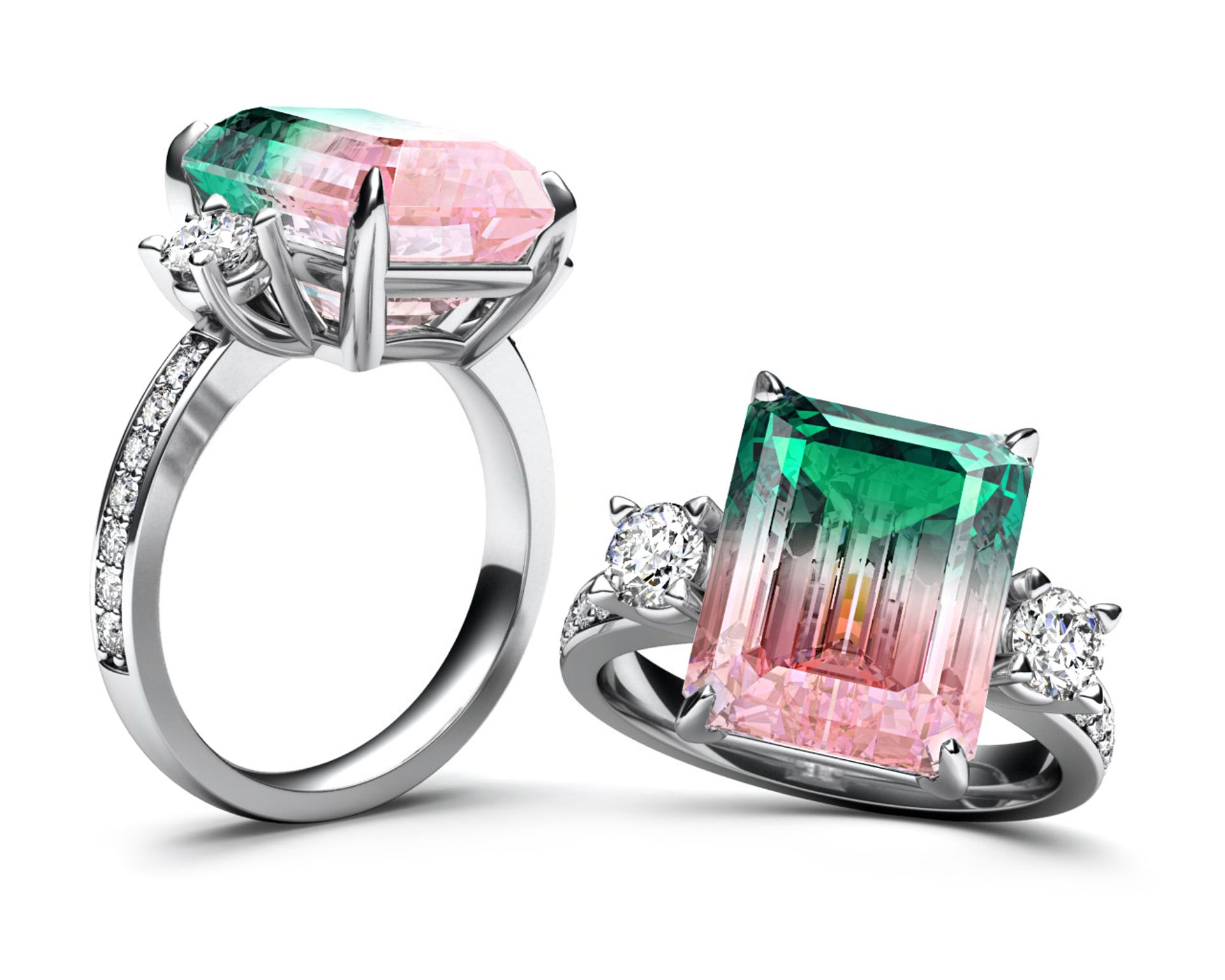
Few gemstones offer as much colour diversity as tourmaline. It can be pink, red, green, blue, yellow, black or almost colourless. Sometimes several colours even occur naturally within a single crystal. This diversity gives tourmaline a special place in jewellery making, too.
- Mineral: a group of more than 40 mineral species, most commonly elbaite (a silicate mineral).1,6
- Colour: a wide range from colourless to black, often with multicoloured crystals. 1,2
- Chemical composition: complex borosilicates, with composition varying by species.1,2
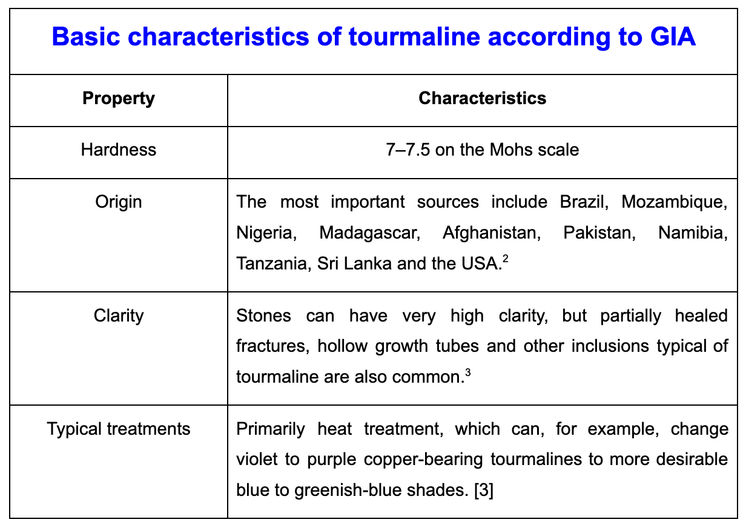
- Hardness: 7–7.5 on the Mohs scale. 1
- Distinctive feature: pronounced pleochroism.3,7
Why tourmaline can be any colour
Tourmalines generally share the same basic crystal structure, but different chemical elements can occupy its individual sites. Their combination determines the resulting colour of the stone. Tourmaline has an exceptionally complex chemical composition.2
According to GIA, the following elements influence its colours:
- iron and probably titanium contribute mainly to green and blue shades,
- manganese produces red and pink and may also contribute to yellow coloration,
- chromium or vanadium accounts for the green colour of some tourmalines.
- copper comes into play in exceptionally rare Paraíba tourmalines (vivid blue to blue-green).2,8 With this coloration, tourmaline can easily be mistaken for an emerald, for example.
The result is one of the broadest colour palettes of any gemstone.1
When a single tourmaline has several colours
The chemical composition of tourmaline can change even as a single crystal grows. If the proportions of colour-producing elements in its surroundings change, the newly forming part of the crystal begins to grow in a different colour. This creates distinct colour zones within one stone.3,6
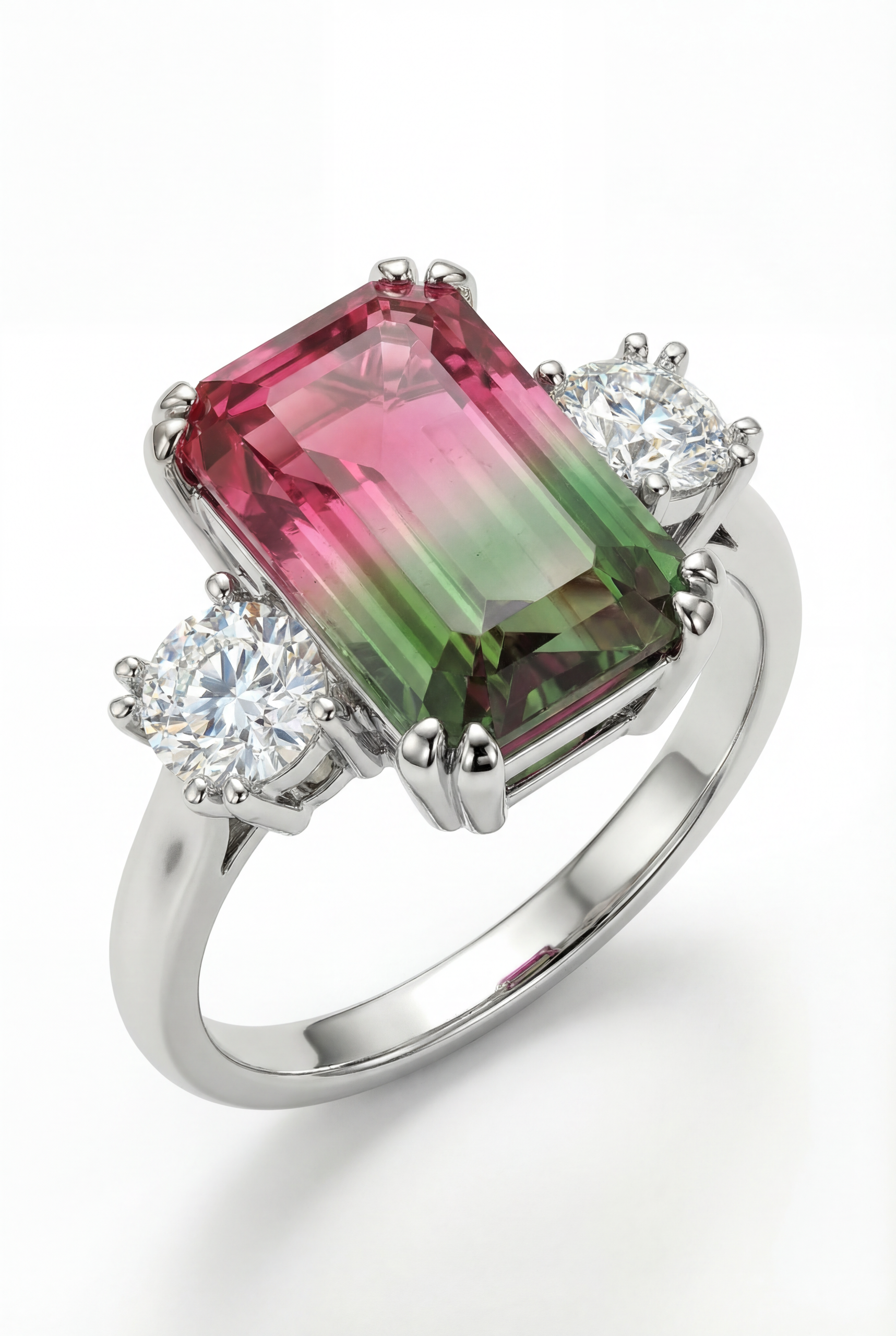
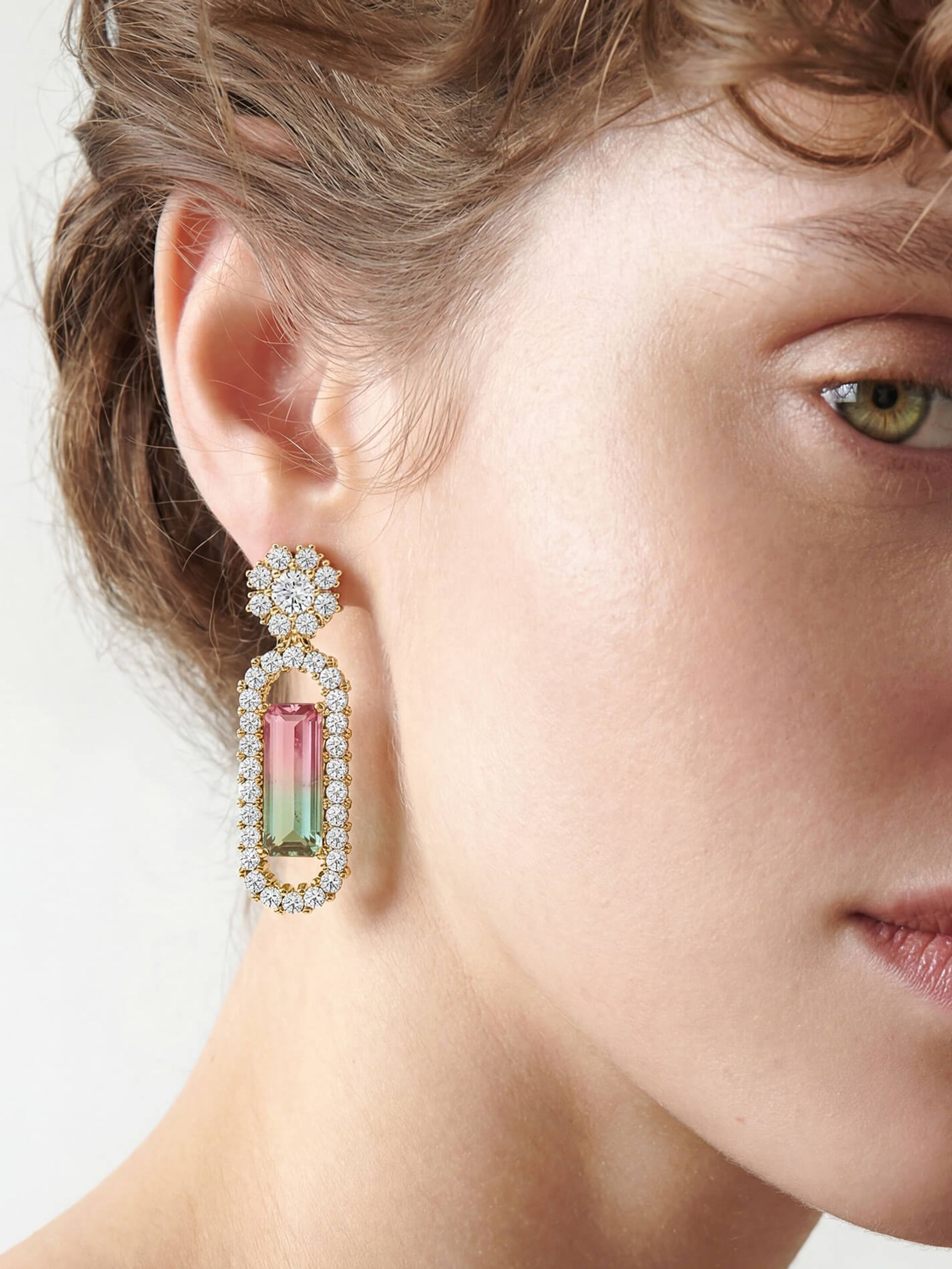
This is how bicolour tourmalines form: stones with two distinctly different colours. A single crystal may start out pink, for example, and gradually transition to green. The boundary between the colours can be gradual or very sharp, making the two parts of the stone look almost like two different gemstones joined together. During cutting, the natural colour distribution can be used to ensure that both coloured sections are clearly visible in the finished piece of jewellery.
A distinctive and well-known example of colour zoning is watermelon tourmaline. Its pink to red centre is typically surrounded by a green outer layer, so a cross-section of the crystal resembles the flesh and rind of a watermelon. This arrangement is what gave the stone its name.3
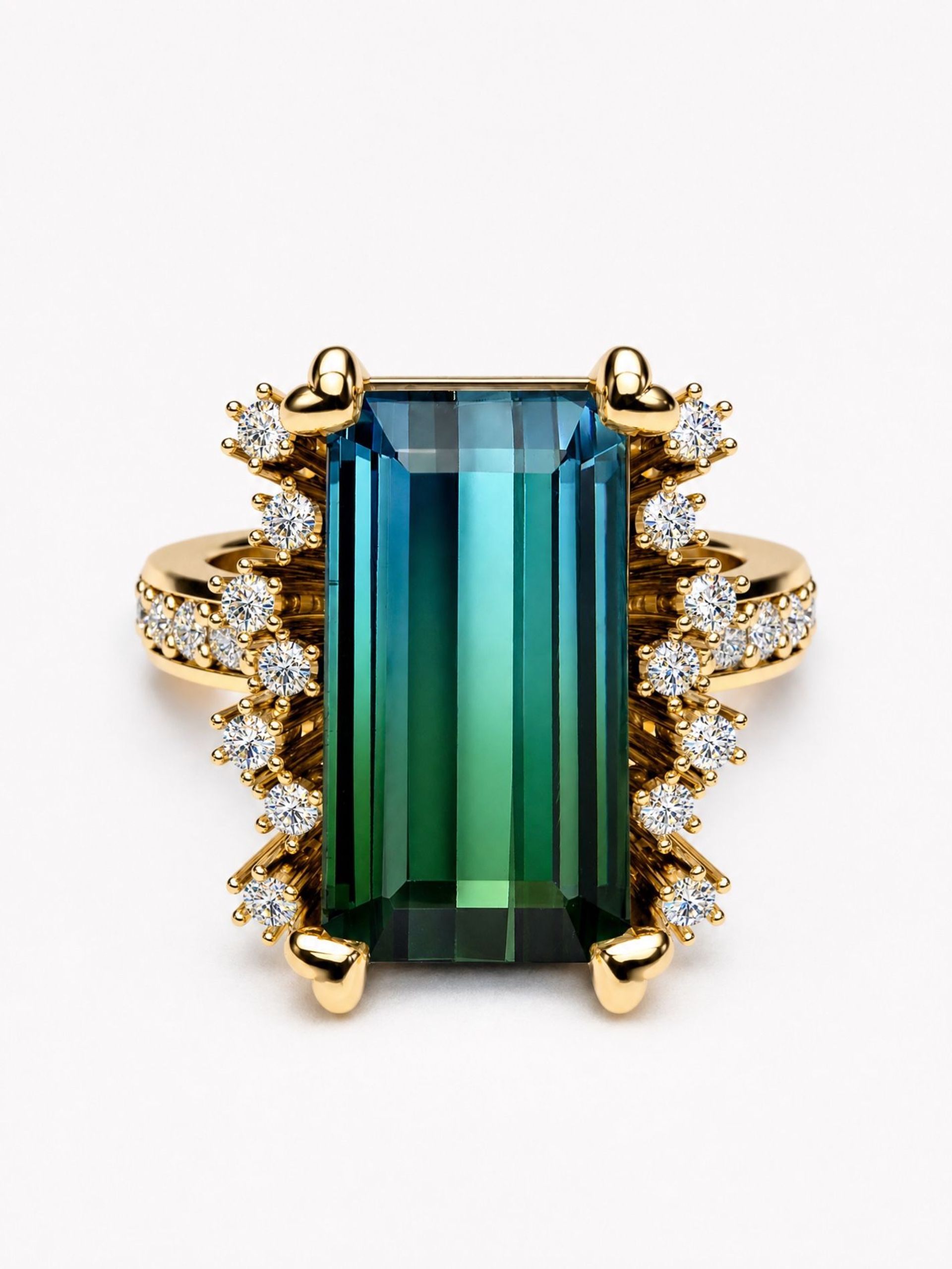
Pink and green are not the only possible combination. Blue-green, green-yellow and brown-green bicolour tourmalines can also be found. The considerable variability of its chemical composition gives tourmaline an exceptionally wide range of colours, allowing each multicoloured stone to have a different distribution, intensity and transition between its individual zones.
Tourmaline changes colour with the viewing angle
Tourmaline is a strongly pleochroic gemstone, a category that also includes aquamarine. When viewed from different angles, its colour may therefore appear lighter or darker, or shift slightly in hue. Our gem cutters must take this into account. The correct orientation of the stone can enhance its colour, whereas an unsuitable cut may, for example, make a green tourmaline appear unnecessarily dark when viewed from above.3,7
Paraíba: the rarest face of tourmaline
Paraíba is among the rarest and most expensive tourmalines, known for its electrifying neon blue to turquoise colour, caused primarily by the presence of copper. The first such stones were discovered in the Brazilian state of Paraíba in the late 1980s. Copper-bearing tourmalines were later also found in Nigeria and Mozambique.8,9
Today, the designation Paraíba is therefore not limited to Brazil. It is used for blue to green tourmalines coloured by copper and manganese that have the appropriate characteristics. A documented, specific geographical origin can significantly affect their value.8
The most valuable examples combine intense neon colour, good transparency, a high-quality cut and exceptional rarity. This is why top-quality Paraíba tourmalines can command very high prices. Independent laboratory documentation is also essential for stones of such value.3,8
Tourmaline treatments
GIA identifies heating and irradiation as the two most significant treatments. Heating can, for example, lighten an overly dark green tourmaline or alter the hue of some copper-bearing tourmalines. Changes produced by properly performed heat treatment are stable under normal conditions.4,5
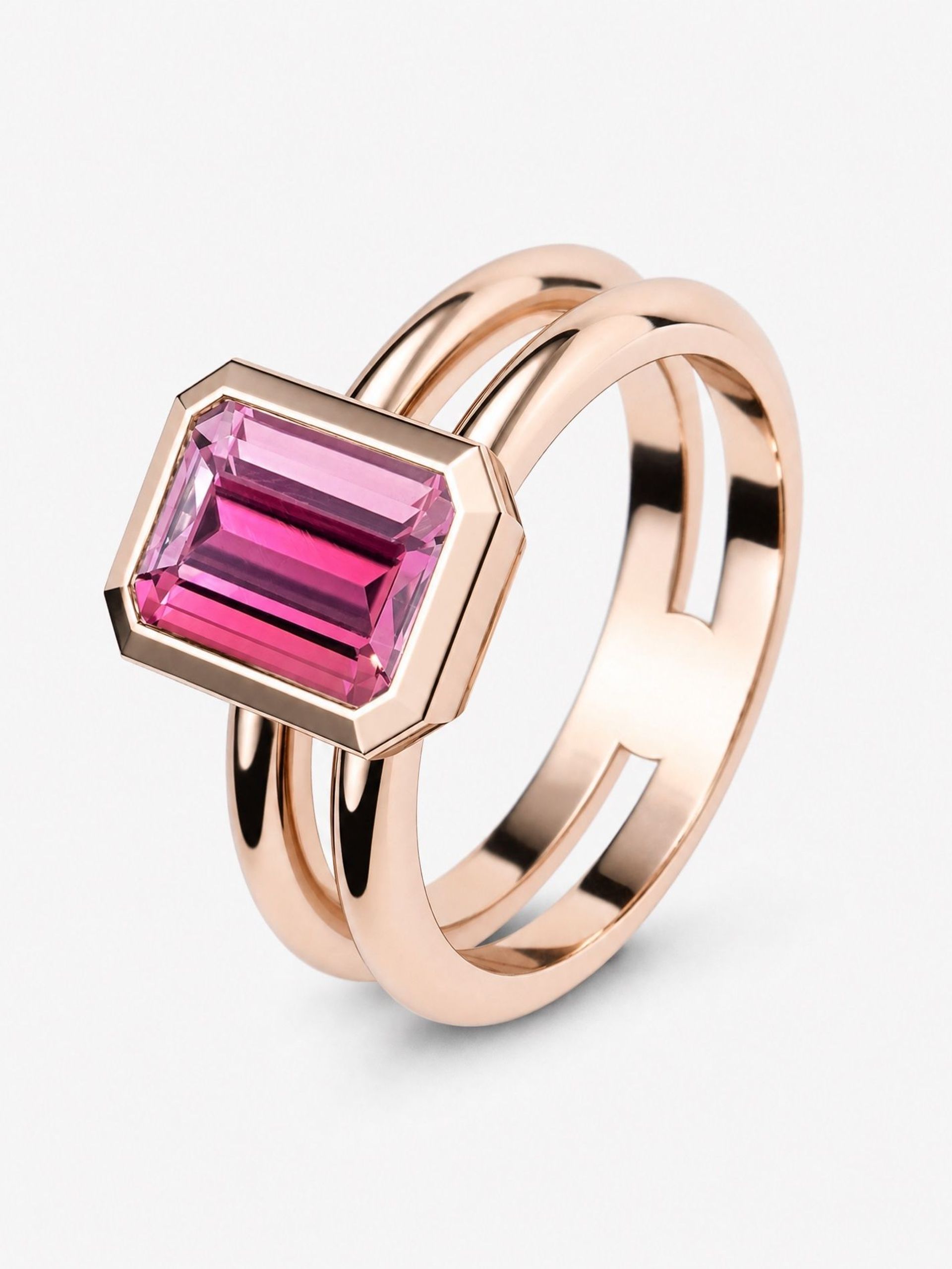
Irradiation is used mainly to change or intensify the colour of some pink and red tourmalines (discover our pink tourmaline ring). Unlike heat treatment, some colours produced this way may be less stable when exposed to strong light or high temperatures.4,6 Fracture filling is less common and visually improves the clarity of the stone. With a more valuable tourmaline, you need to know exactly what you are buying and whether any treatments have been transparently disclosed.
How to choose a truly high-quality tourmaline
There is no single “best” tourmaline. Different colours have different criteria, and diversity is one of its greatest strengths. Book an appointment at our studio in Prague or Brno, where we will be happy to advise you and help create the perfect piece of jewellery with tourmaline or another coloured gemstone.
When choosing, focus on the following factors
- The colour must work as a whole. For most tourmalines, colour is the most important factor determining value. Pure, saturated shades without overly dark or black areas are highly prized.3
- Examine the stone from several angles. Strong pleochroism means that it may change hue or darken when tilted. A well-cut stone uses this effect to its advantage.3,7
- Assess clarity according to the particular colour. Inclusions are more common in pink and red tourmalines and are more readily accepted by the market. Green stones, on the other hand, are expected to have higher clarity.3
- With multicoloured tourmalines, pay attention to the boundary between colours. Attractive, clearly separated zones can be an asset rather than a flaw.3
- Laboratory documentation makes sense for exceptionally valuable stones. It can confirm the gemstone’s natural origin, detectable treatments and, for some tourmalines, geographical origin as well.8
Tourmaline gives us limitless inspiration
Tourmaline’s greatest strength lies in its diversity. Each crystal can offer a different combination of colour, pleochroism, inclusions and colour transitions. For our bespoke jewellery, however, the most sought-after stones today are bicolour tourmalines, whose natural colour pattern forms part of the jewellery design. At the Korbička studio, the name of the stone is not all that matters. It is the individual specimen that counts: its colour, proportions, cut, character and the way it will work in the finished piece of jewellery.
Sources:
[1] GEMOLOGICAL INSTITUTE OF AMERICA (GIA). Tourmaline – Gem Encyclopedia [online]. [accessed 2026-09-19]. Available at: https://www.gia.edu/tourmaline
[2] GEMOLOGICAL INSTITUTE OF AMERICA (GIA). Tourmaline Description [online]. [accessed 2026-09-19]. Available at: https://www.gia.edu/tourmaline-description
[3] GEMOLOGICAL INSTITUTE OF AMERICA (GIA). Tourmaline Quality Factors [online]. [accessed 2026-09-19]. Available at: https://www.gia.edu/tourmaline-quality-factor
[4] GEMOLOGICAL INSTITUTE OF AMERICA (GIA). Tourmaline Care and Cleaning Guide [online]. [accessed 2026-09-19]. Available at: https://www.gia.edu/tourmaline-care-cleaning
[5] GEMOLOGICAL INSTITUTE OF AMERICA (GIA). An Introduction to Gem Treatments [online]. [accessed 2026-09-19]. Available at: https://www.gia.edu/gem-treatment
[6] RENFRO, Nathan, Tyler SMITH, John I. KOIVULA, Shane F. MCCLURE and James E. SHIGLEY. Micro-Features of Tourmaline. Gems & Gemology [online]. 2024, 60(2). [accessed 2026-09-19]. Available at: https://www.gia.edu/gems-gemology/summer-2024-micro-features-tourmaline
[7] HUGHES, Richard W. Pleochroism in Faceted Gems: An Introduction. Gems & Gemology [online]. 2014, 50(3). [accessed 2026-09-19]. Available at: https://www.gia.edu/gems-gemology/fall-2014-introduction-pleochroism-faceted-gems
[8] KATSURADA, Yusuke, Ziyin SUN, Christopher M. BREEDING and Barbara L. DUTROW. Geographic Origin Determination of Paraíba Tourmaline. Gems & Gemology [online]. 2019, 55(4). [accessed 2026-09-19]. Available at: https://www.gia.edu/gems-gemology/winter-2019-paraiba-tourmaline-geographic-origin-determination
[9] FRITSCH, Emmanuel, James E. SHIGLEY, George R. ROSSMAN, Meredith E. MERCER, Sam M. MUHLMEISTER and Mike MOON. Gem-Quality Cuprian-Elbaite Tourmalines from São José Da Batalha, Paraíba, Brazil. Gems & Gemology [online]. 1990, 26(3). [accessed 2026-09-19]. Available at: https://www.gia.edu/gems-gemology/fall-1990-tourmaline-brazil-fritsch